Back to library

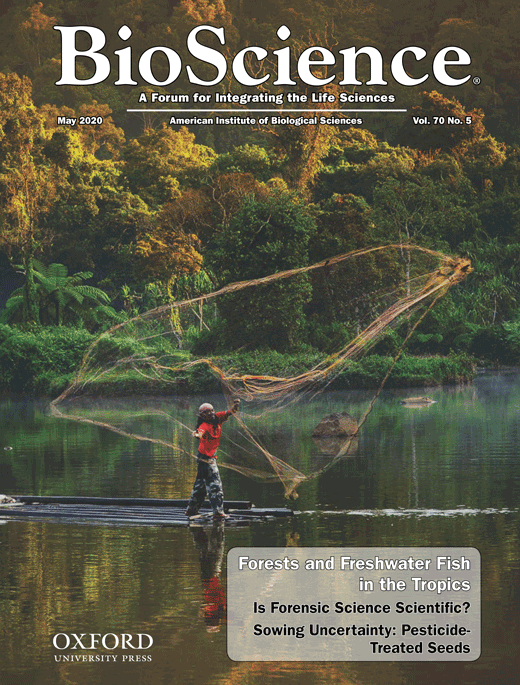
BioScience

Since 1964, BioScience has presented readers with timely and authoritative overviews of current research in biology, accompanied by essays and discussion sections on education, public policy, history, and the conceptual underpinnings of the biological sciences.

A peer-reviewed, heavily cited, monthly journal with content written and edited for accessibility to researchers, educators, and students alike, BioScience is provided to all AIBS members in print and online as a part of regular AIBS dues.

BioScience includes articles about research findings and techniques, advances in biology education, professionally written feature articles about the latest frontiers in biology, discussions of professional issues, book reviews, news about AIBS, a policy column (Washington Watch), and an education column (Eye on Education). Roundtables, forums, and viewpoint articles offer the perspectives of opinion leaders and invite further commentary.
Records in our library from this publisher

A Vicious Circle? Altered Carbon and Nutrient Cycling May Explain the Low Resilience of Caribbean Coral Reefs

2016
Journal Article

Coral reefs are economically important ecosystems that have suffered unprecedented losses of corals in the recent past. Why have Caribbean reefs in particular transitioned to coral-depleted systems and exhibited less coral resilience? A synthesis of recent research from diverse sources provides novel insights into the reciprocal interactions among sponges, seaweeds, and microbes. We propose that coral loss resulted in more abundant seaweeds that release dissolved organic carbon (DOC), which is consumed by sponges. Sponges return carbon to the reef but also release nutrients that further enhance seaweed growth. Both seaweeds and sponges compete for space with the remaining corals, and the cycling of carbon and nutrients alters microbial activity, with negative consequences for the coral microbiome. Adding to these interactions are geographic factors that enhance nutrients and DOC on Caribbean reefs, such as river discharge and windblown dust. Relatively higher abundances of sponges and the absence of phototrophic species suggest that sponge communities on Caribbean reefs have adapted to a different nutritional environment than is present elsewhere. This synthesis sheds new light on past hypotheses seeking to explain the disparity in the recovery of coral reefs across the tropics, provides new directions for research, and has implications for the conservation of Caribbean coral reefs that are related to fisheries and watershed management.

BioScience